Monday, July 15, 2013

There and Back


I'll not miss the window unit and its constant assault on the swelter.  Volubly, with a cyclic growl, it has attempted a desperate, Quixotic alchemy of golden coolness wrought out of leaden humid heat.  But then it is July in Key West.  We didn't anticipate mountain air.  We got the tropics we reasonably expected.  

And any number of extra showers.

We walked the streets when taxis weren't justified.  We dealt with myriad wedding details -- hair and face, flower and song, taste and vows and tables and chairs -- and we ate.  Seafood, mostly.  And Key Lime pie.  I willfully lost count of how many pieces but Lori kept scrupulous tally.  We watched for sunsets off the coast, but rain and its anticipatory clouding kept them largely veiled.  Perhaps October, when we return, will find them liberated and free for the taking.  

For now, encompassed by the treasure of special time alone with each other and with the wedding couple, we are headed home to a dry garden, a return to work, two busy puppies we have missed more than we like to admit, and "normal" life that most days already feels like something of a vacation.  Blessed, and then doubly blessed.

Which is to comprehend all over again that going is good; returning is even better.  

Wednesday, April 17, 2013

A Modest Post-Bombing Proposal

In the immediate aftermath of the Boston Marathon bombing, President Obama went on television to assert that, “We still do not know who did this or why.  And people shouldn't jump to conclusions before we have all the facts.  But make no mistake, we will get to the bottom of this.  And we will find out who did this; we’ll find out why they did this.  Any responsible individuals, any responsible groups, will feel the full weight of justice.”

Fine.  That is as it should and must be.  But while my emotional curiosity aches for answers to the questions the President voiced -- “who” and “why” -- my real concern is with a different question:  “what then?”  That answer, after all, is the one that will very likely be consequential. 

Justice demands that we answer the “who”, and hold him or her or them accountable.  But frankly the “why” offers precious little purchase.  The perpetrator’s particular complaints and condemnations will be spoken with their own nuance and inflection, but their essence isn't all that inscrutable -- and ultimately isn't all that relevant.  The act is heinous.  Does it really matter why it was committed?  Will any explanation assuage even one scintilla of the grief, the horror, the shock, the anger?  Someone was murderously mad about some personal or cultural grievance and unilaterally took violent action to right the perceived wrong, or flag the assessed outrage.  The technologies and the settings evolve and change but the rationales do not.  So answer the “who” but let go of the “why.  It's answer won't finally help or salve or matter.

But what happens next -- with us; among us?  That's what worries me. Our track record with that question isn't good.  Especially since 9/11, and again after every major tragedy since, we have propagated the delusion that we can prevent such acts from occurring.  We have installed X-ray machines and metal detectors at every entrance, imposed invasive searches, signed into law more and more restrictive legislation and broadened governmental surveillance authority, all under the belief that we can finally and conclusively “seal the can”, thereby eliminating any possible malevolent intrusion.  

The only problem is that we can't. We can only suffocate ourselves by the effort, and through the gasping only make ourselves more vulnerable by the delusion. To be clear, this isn’t an ode to fatalism, nor is it a concession to those who argue for more weaponry in the hands of ever more people.  No, they may be the most delusional of all.

Instead, this is a modest invitation -- plea, really -- to pause, back up and ponder the dynamics and relationships that give shape to our reality.  We cannot survive in bunkers.  And who would want to?  I am already sick enough of the war zones our airports have become that I look for alternate means of travel.  As long as there are people we will find ways to hurt each other, and to retaliate against them.  

The only sane answer to the question of “what next” is not to find more strident means of “protection”, but to seek and practice more effective, life encouraging methods of living together.  

Is that a fool-proof strategy that will prevent anyone else from getting hurt?  Of course not.  There simply is no such strategy.  The advantage of this course is that it is one in which, instead of merely hiding with our teeth clenched and our guns cocked while frisking each other every so often, we have some hope of actually living.  

Monday, March 18, 2013

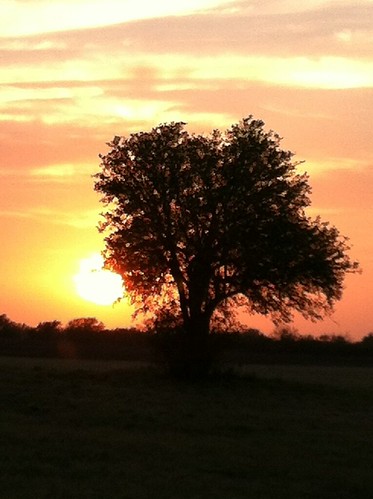
The Setting -- and Settling Berclair Sun

The sun doesn't set in Iowa; at least not in our part of it -- not like this. Yes, the day comes to an end; yes, the sun goes away. Night eventually envelopes us. But there is no “sunset” on this scale. Perhaps it is the trees that veil the view. Perhaps it is the rolling topography that interrupts the horizon. In the city, to be sure, there are all the buildings reaching up like fingers in front of a baby’s eyes, curtaining everything on the other side.

Or it could, of course, be that the problem is less “Iowa” and more “home” wherever that may be -- home, where we are busy, moving to and fro; indoors and preoccupied with our weariness alongside we have or have not accomplished and all that needs to be done.

It's too bad. There is something almost medicinal about the setting sun -- meditative, I suspect, even for the non-spiritual. That settling fire becomes a vortex, hypnotically focusing and drawing all it touches into its own mellowing transformation from hot yellow to warm orange to confectioner’s striations of pink and lavender and mauve. Before we are even aware of it we, too, have settled. And with that, it's work somehow complete, it drops below the horizon, out of sight as in an instant, until tomorrow’s rising -- somehow knowing, I suppose, that its work is never done.

It will be hard to leave this evening ritual -- drifting out to the circled chairs under the trees out back, taking our places on the east side of the arc, instinctually facing west; offering ourselves, as it were, into the dusky ministrations of God’s first creation.

And being somehow recreated, ourselves.

Sunday, March 17, 2013

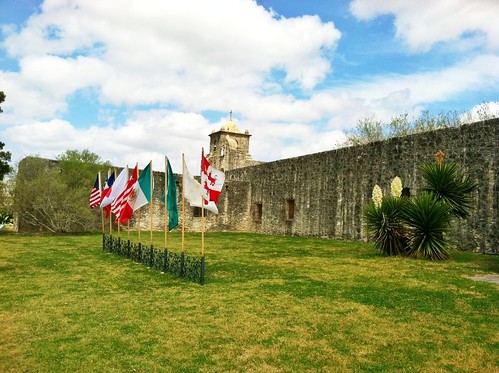
La Bahia Goliad

La Bahia Goliad by Taproot Garden
La Bahia Goliad, a photo by Taproot Garden on Flickr.

Dance music incongruously blares from the historic courtyard where a DJ is testing his sound system for a wedding scheduled later in the afternoon. It is a jarring disruption, and strikes us as a singularly curious choice for nuptials, here where almost 177 years ago -- on Palm Sunday, March 27, 1836 -- 342 soldiers lost their life. “Here” is the Presidio La Bahia at Goliad, Texas where once again we have made pilgrimage. I suppose one could argue that our presence is as odd as the bride and groom’s. We have, after all, been here before. Many times. And as I mentioned, it isn't a happy place.

La Bahia is not the site of a battle. The soldiers did not die in combat. They were prisoners of war slaughtered, in a dramatic presumption of ends justifying means, by their captors. Having surrendered a week earlier, at the Battle of Coleto Creek, under the written assurance of favorable treatment, Colonel James Fannin and his fellow independence fighters were marched back to the fort they had previously occupied as defenders. A week later, under orders from the Mexican President Santa Ana, they were marched back outside, circled and fired upon at close range. A couple dozen managed to survive and escape. A similar number were spared for practical reasons. The bodies of the massacred were simply abandoned where they fell. 342.

It isn't a moment in the popular lore of Texas history that has sustained the high profile mystique of the Alamo -- John Wayne never made a movie about Goliad, nor anybody else in Hollywood for that matter. It was, nevertheless, a galvanizing episode in the Texans fight for independence that was eventually won, a few short weeks later, at the Battle of San Jacinto. But if I have ever been to San Jacinto I don't remember it; and though I have visited the Alamo a few times it feels compelled by a sense of obligation; a historical duty of birthright.

I haven't quite fathomed these pilgrimages to Goliad. Perhaps it is mere proximity or the quietude’s lack of other things to do. Perhaps it is the nostalgic lure of my family’s roots in this area just 15 miles away, making it “ours” in a way only abstractly and collectively true of the Alamo some 90 miles away.

I can't help but sense, however, that the story itself is the hook and line that draw me back again and again -- fathoming the cold calculations of the brutal orders; imagining, or perhaps hoping for, the ambivalence of those carrying them out; channeling the apprehension of those prisoners first rousted and then rustled outside; smelling, even after all these years, the gunpowder and the blood; both hearing and feeling the wing-beats of buzzards descending in subsequent days; and grieving, yet again, the capacity of humankind to treat our fellows as nothing.

I don't know why a couple would choose to get married there -- there among such memories and echoes. But I rather appreciate the symbol of it. In the same way as a dog marks its territory -- overriding the scent of a previous presence -- perhaps a wedding’s declaration of love and hopeful creation is the perfect mark to spray on a site whose prior scent was a noxious and nauseous cocktail of arrogance, ambition, and brutal disregard for the sacredness of life.

I hope the happy couple lives happily ever after. And has lots and lots of kids. 342.

Saturday, March 16, 2013

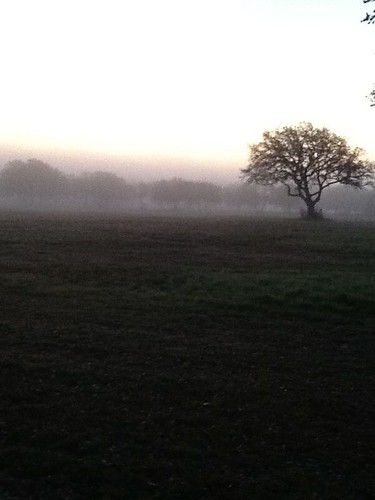
Berclair Morning

Berclair Morning by Taproot Garden
Berclair Morning, a photo by Taproot Garden on Flickr.

The music of birds I can't identify chirp the Berclair morning through the heavy haze cloaking the trees and into orange light. What had been night’s near-silence crescendos in a seeming instant to morning’s lively chatter. Whistles from branches, dew drips from the eaves, ratcheting from insects hidden in the field, and off in the distance a passing car. It is a wondrously busy transition this creep from night to day. I am seemingly the only life quiescent, the slight rocking of my front porch chair channeling the lulling breeze.

We will have our own activity in the course of the day -- a water pump to assess and its timer to verify, a nascent crop to appreciate and coax, a new fence to confirm. But the real work of the day -- the more pressing business for which we traveled to this family farm almost a country and a lifetime away -- is to ebb, for awhile, the relentless waves, settle into deeper grooves, listen again to long-dead voices, and to stand submissively aside while nature and our souls do the talking.

The dawn’s orange has dissolved into morning’s white; the sun is on the verge of cresting the trees. With a good part of my day well underway, it’s time for a second cup of coffee. And maybe a pancake or two.

Tuesday, February 12, 2013

So, Didn't God Make a Farmer?

In the ensuing couple of weeks since the Super Bowl, I have been fascinated by the varieties of responses sprouting up to the Dodge Ram ad that utilized a voice-over from an old Paul Harvey speech focusing on God's need for farmers, covering various images of said farmers.  Those responses have ranged from tender, melancholic reminiscence to a near-reverent appreciation, to scathing condemnation.  The ad agency responsible for the piece has got to be smiling.  It was, after all, an advertisement whose presumed purpose was to catch public attention and sell a product.  I can't speak to the latter, but as to the former the ad has been a decided success.

As to the ad's critics, their judgments are absolutely fair.  Had the 2-minute piece been a documentary it would have been sadly, shamefully flawed -- leaving out virtually 90-percent of those responsible for moving our food into, then out of the ground, off the stem and into our markets.  The rosy, sentimental pictures of hardworking white families certainly overlooked the vast domination of agribusiness that largely renders such pictures ersatz greeting cards.  And yes, totally neglected were all the migrant farm workers -- mostly non-white and by-and-large stooping to their task illegally -- on which our food system utterly depends.  Only hinted at in the rhapsodic prose were the challenging and sometimes impossible economics that have wedged many farmers between the rock of expensive mechanization and the hard place of harvest vicissitudes and capricious credit -- pressures that have squeezed far too many off their land.  Yes, there are farmers like those depicted in the ad -- many of them -- who work every bit as hard as pictures and the narration suggested.  But fewer and fewer.  It's not that the ad told a false story; it just didn't tell very much of the true one. 

I hope that someone might come along who has as much documentary skill as Ken Burns and as much gravitas as Paul Harvey to tell these real and poignant stories as compellingly as Dodge managed to communicate the ones in its ad.  They deserve to be heard.  They deserve to be honored and appreciated and, well, paid.

But let's face it, that's not what the Super Bowl ad was aiming for.  Dodge didn't buy those extravagant prime-time minutes to air a documentary, and painful sociological statistics don't sell vehicles.  It wasn't trying to "tell the truth," it was trying to sell trucks.  As such, that well-crafted piece of economic art wasn't targeted at those thousands of farm workers who really struggle to survive under the weight of all those challenges and burdens enumerated by that beloved voice.  The ad was targeted at that 10% -- or 1% -- who can actually buy the truck. 

And I suspect I know what images and words might just cross their mind the next time they are shopping for a new ride.

Thursday, February 7, 2013

For the Love of Lettuce


"Another Pleasant Valley Sunday; charcoal burning everywhere.  Rows of houses that are all the same.  And no one seems to care."  
                               ---words and music by Gerry Goffin and Carole King
It's hard to know whether to be heart-sick, angry, or simply embarrassed.  Because of a few complaints, the West Des Moines City Council has agreed to consider a ban on all "front yard vegetable gardens."  After all, as the article in today's Des Moines Register points out,
"Cabbages, once picked, leave holes. Squash leaves can get scabby-looking, and a blighted tomato plant is downright ugly...  Leggy sweet corn plants can seem scraggly and disproportional, especially in contrast to a well-manicured lawn."

And God knows that the situation is urgent.  As one concerned citizen puts it, “What’s to prevent them or anyone else now from, this spring, bulldozing their entire front yard and planting a garden?  If you don’t have anything in your ordinance to prevent this, I could see that happening.”

Exactly.  And what could be worse than an entire front yard full of...food?  Food that could be...well...eaten -- stretching grocery dollars, saving gas, and quite possibly improving our diet?  Yes, that all sounds like quite the public nemesis.

Can we just stop and have a reality check?  I suspect that this might be one of those moments when my Dad would say, "the world's going to hell and we're arguing over tomatoes."  Surely there are more mountainous issues for a community to be wrestling with than such puny molehills as this -- perhaps educational excellence or gun violence or access to health care or simply public health!  Moreover, at a time in our agricultural history when we ought to be encouraging everyone who has any plot of sunny soil available to sow a few seeds and not only participate in but contribute to the food supply, the last thing we should be doing is erecting impediments.

It's hard to know if this proposed ordinance stems from a hyper-carnivorial hostility to all things vegetable, or an overly steroidal devotion to some blandly homogenous suburban "aesthetic", or a subtly obfuscated slap at the poor who some West Des Moinians prefer to believe don't exist within their city limits.  Regardless, the notion is too repugnantly silly to even be funny -- let alone take up precious City Council time.

On the off-chance that reason does not eventually prevail in West Des Moines, I am modestly prepared to plow into the lunacy with the creation of a "Vegetable Rescue League" that would provide safe-haven on our humble acreage to any allium, brassica, night-shade, pepper or edible root forced to flee the city limits as horticultural refugees -- sort of a "green" Red Cross offering soil sanctuary for salads-in-process.

Compassion, and I like to think "sanity", in action.  That, and my little mission to prove the song wrong.  Somebody does "seem to care."